Thoughts While Sitting at the 2025 World Science Fiction Convention in Seattle.

Sitting in the dealers’ room at the 2025 World Science Fiction Convention (WorldCon) in Seattle. Wearing my replica TNG-era com badge and Starfleet delta earrings. I didn’t wear my Manticoran Navy officer’s uniform because my involvement in the TRMN has waned significantly. A gentleman sitting at the same table is wearing his uniform, and I said, “Go Manticore!”, but he ignored me.

My publisher threatened to take away my author card if I didn’t autograph copies of my books at his table. So, if you want some autographed books, you can head over to Water Dragon Publishing, or, better yet, send me an email and I’ll be happy to address an autograph to you personally.

The first ribbon I attached to my member badge says, “No Kings.” I picked it up at the registration desk before I even obtained my dealer badge (ribbon). Dozens of people have asked me where I got it, and when I tell them, they respond, “There weren’t any there when I went through registration.”

Sorry, dude. Can’t help you with that. I haven’t seen many No Kings ribbons, so I’m thinking they may have been a limited run.

I’m not seeing many panels on today’s schedule that I want to attend, but there is one at 19:30 tonight that looks interesting:

Why Does the Alt-Right Love Science Fiction?

The description: Over the past few decades, there have been attempts to co-opt science fiction in support of racist, sexist, and classist political movements. Even works such as Star Trek, Neuromancer, and The Dispossessed have been claimed by alt-right leaders as foundational texts for their awful worldviews. Why does the alt-right love science fiction, and what problematic assumptions are coded into the genre that cause it to be open to these interpretations?

First off, anyone who wonders, “When did Star Trek become so woke?” has had their head up their butt since 1966. 

Second, I’m well aware that embracing science fiction fandom has placed me solidly in a progressive echo chamber. If the bulk of Sci-Fi fans had their druthers, The Felon and his cronies, along with all the White Christian Nationalists, would have been launched into a parallel universe long ago, where they can play out their Project 2025-basedmasturbatory fantasies without bothering other people.

That’s not to say that there aren’t any Republicans at the Con today, but they tend to keep their political opinions to themselves and quietly back out of conversations that turn political. And they tend to be the kind of Republican who’d vote for Eisenhower or Nixon, but not The Felon.

Thirdly, I have a dinner engagement tonight, but if I can get back to the Con before 19:30, I’ll attend this panel.

What do I do about the echo chamber? Truthfully, not much. I remind myself that the loudest progressives are just as guilty of not fact-checking their talking points as Fox News is. I mean, really, people just don’t google it when it supports their agenda. 

Apropos of nothing, here is a Hawaiian Dalek.

Death by Cooties: A Martian Mystery


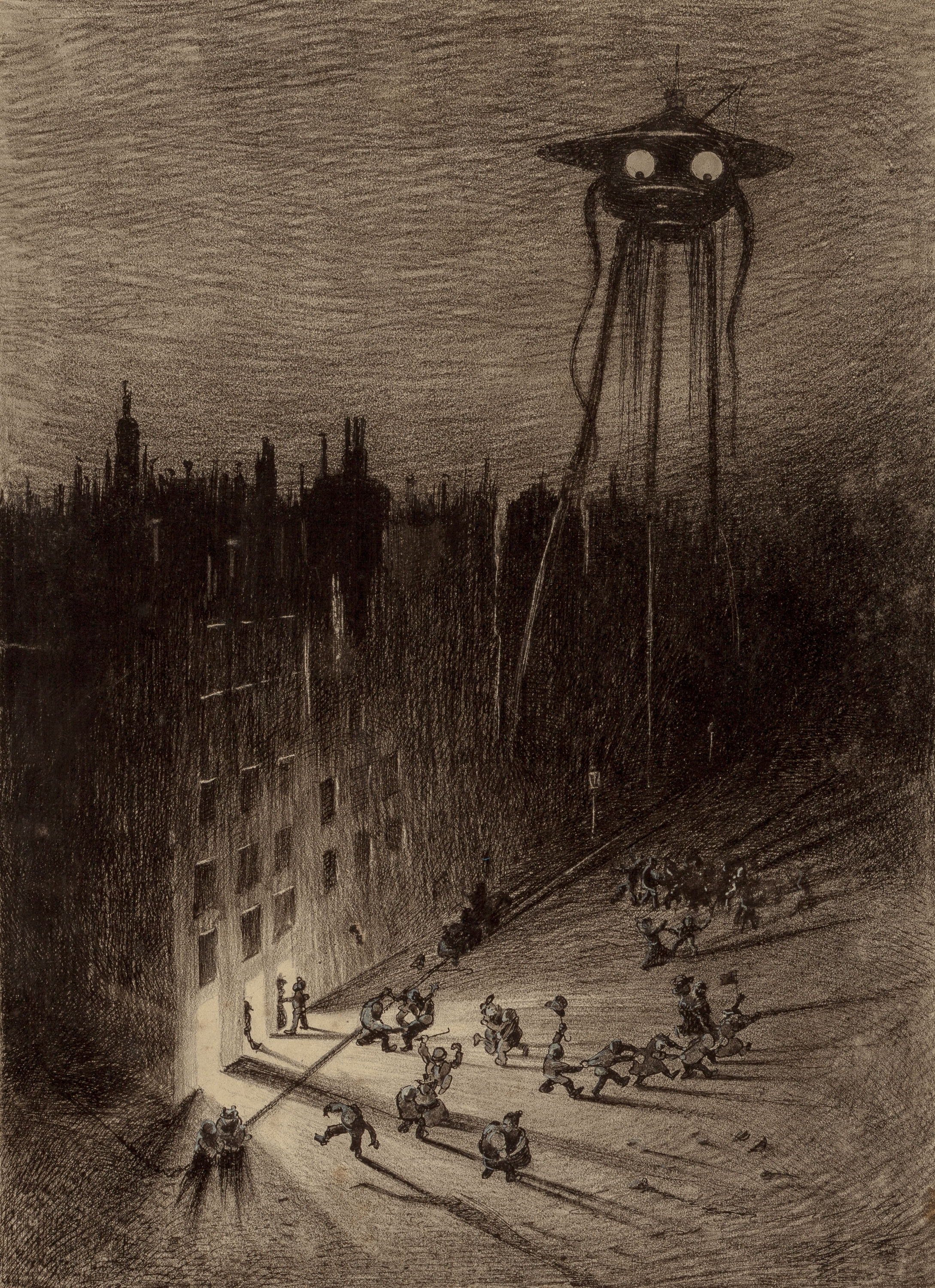
Illustration by Henrique Alvim Corrêa, from the 1906 Belgium (French language) edition of H.G. Wells’ “The War of the Worlds”, 1906. License: Public Domain

In H. G. Wells’ classic War of the Worlds, the invading Martians are defeated by microbes, to which the Martians have no immunity. When the book was written in 1898, the readers thought this was a clever turn of events. Wells needed a way to defeat the Martians without relying on conventional military victory, and used germs as a deus ex machina that relied on science and not gods, and showed how the hubris of the Martians was brought low by the humblest of life forms.

“And so the Martians fell… slain by the putrefactive and disease bacteria against which their systems were unprepared.” — H.G. Wells

However, 127 years later, it’s hard not to squint at this plot twist. I doubt my thoughts here are original, but they’ve been festering in my brain long enough that I feel compelled to write them down.

Plot Hole #1: Advanced Civilizations Should Know About Germs

First, the advanced Martian race should have known about germs and how to deal with them. After all, the existence of megafauna, such as the Martians, implies the existence of microorganisms, just as the existence of planets implies the existence of atoms. This is a humungous plot hole.

On Earth, microbes are ubiquitous, filling every possible environmental niche from the bottom of the ocean to the lint in your belly button. They are fundamental to every ecosystem, including the digestive systems of larger animals. It’s nearly impossible to conceive of a complex biological system capable of supporting megafauna, like the Martians or any other large creature on Mars, that does not also involve a vast microbial landscape.


Let’s ignore the realities of what we know about Mars and assume for a moment that the fourth planet has its own long evolutionary history. The Martians would have co-evolved with Martian pathogens and would have developed their own immune systems to deal with their native germs. The Martians would have almost certainly developed an understanding of disease, hygiene, and germ theory. They would have had their own plagues and epidemics throughout their history.

At some point before the invasion, some Martian scientists working for the Martian Space Agency would have said, “Y’know, we really should send a robotic probe to check out the air and water to make sure it’s safe for us.” Had they not considered this, then, shit. The universe has little patience for civilizations that skip the basic biohazard protocols.

Plot Hole #2: Why Would Earth Germs Recognize Martians as food?


The Martians evolved in a world completely isolated from Earth. What are the odds that Earth-based germs would find the Martians tasty? Or would even be able to find a way to infect them? 


Our microbes on Earth have evolved over billions of years to exploit the organic molecules and metabolic pathways that we depend on: breathing, eating, and drinking. The micro-beasties have evolved enzymes and receptors to interact with Earth-based proteins, sugars, and lipids. We are in a biological arms race with germs — we develop immunity, and the germs find novel ways to infect us. 

The converse is true with Mars. Earth-based microorganisms would probably not recognize Martians as food or a host. 

Science Fiction, Not Science Fact — And That’s Okay

None of this is meant to disrespect Wells or the book. The War of the Worlds is a foundational work of science fiction, and its denouement is memorable, iconic, and metaphorically powerful. Wells used the science available to him in 1898 to craft a compelling narrative, even if it doesn’t stand up to 21st-century astrobiological scrutiny. 

That said, the bigger question is this: Why does Hollywood keep falling back on such a well-trodden trope?

I know — the answer to that question is always “money.”

Every time we watch another remake of War of the Worlds, we already know how it ends. Spielberg used it less as science fiction and more as a mirror for Americans’ post-9/11 insecurities. But let’s be honest: if he hadn’t signed Tom Cruise, Dakota Fanning, Tim Robbins, and Morgan Freeman, I doubt it would’ve had the same impact.

And speaking of casting calls

One moment in Spielberg’s War of the Worlds (2005) that I genuinely appeciated was the cameo of Gene Barry and Ann Robinson — the stars of the 1953 adaptation — as the grandparents in the final scene. It was a graceful nod to the film’s lineage, acknowledging the cultural staying power of Wells’ story and the generations of audiences it has haunted (and inspired). For all my criticisms, I have to give Spielberg credit for honoring the franchise’s legacy.