
A little story about my vacation in Europe
The Viking River Cruise ships (I will delete any comments about raiding monasteries) are like miniature ocean cruise ships. They only carry 190 passengers, but the amenities are much the same. They serve gourmet breakfast, lunch, and dinner, though I stopped drinking wine and eating dessert for lunch after about the fourth day.
One morning at breakfast, we were joined by a lovely couple from Arizona, Karen and Dan. We exchanged life stories and I mentioned that I was an author.
At Dinner, Karen informed me that she had purchased the Kindle version of my book, Memory and Metaphor and was really enjoying it.
Best vacation ever!!
I can deduct the cost of the trip from my taxes now, right?
Day 14: Vienna and the Cruise Crud
Full Moon over Vienna
While riding the bus back from Salzburg to the boat, I heard several people coughing. And not just an irritated throat cough. These coughs came from deep in the chest and sounded wet.
And I didn’t have a mask. We started wearing masks after that, but it was too late. Beth was the first to get sick, and then I came down with a congested chest and a stopped-up nose last night. One of the other passengers started calling it the “Cruise Crud.” Beth is much sicker than I am, but she’s not down and out yet. I can’t sleep with these sinuses, so I’m up writing this blog post at 03:30.
Vienna has a population of almost two million people, and it feels like it. Walking downtown, it’s difficult to avoid bumping into people, and most of them aren’t watching where they’re going. And younger people will often not even attempt to avoid you, assuming that you’ll avoid them. Even though it’s the off-season, the city feels like it’s choked with tourists, Beth and I among them. I can’t even imagine what it’s like in the warm months. The city feels like San Francisco in that respect.
However it is a clean city with low crime and unemployment rates. It has enchanting architecture, is the cradle of classical music, and there are coffeehouses everywhere.
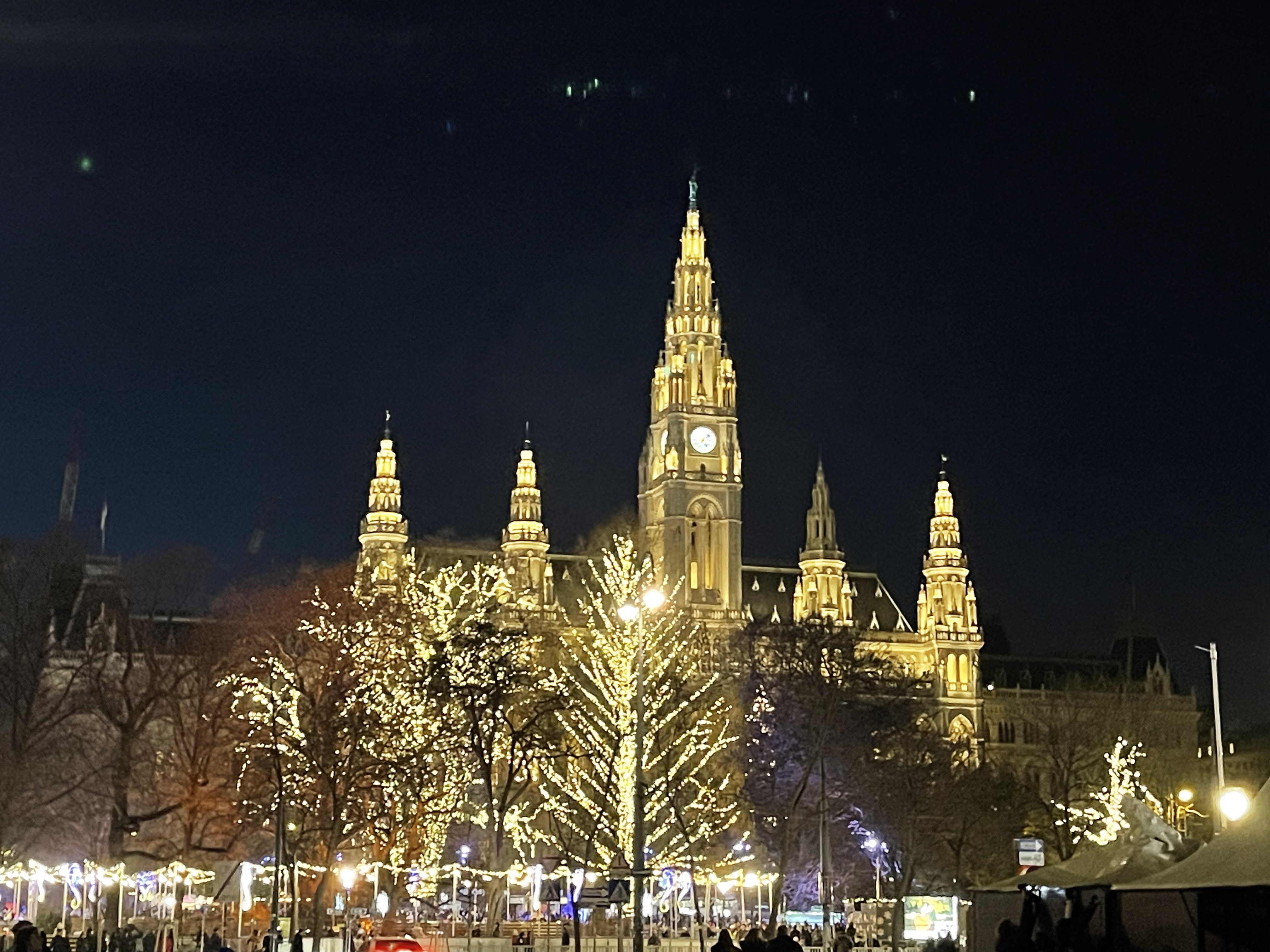
After visiting the Lipizzaner Stallions at the Spanish Riding School, we went back to the boat for dinner, then got back on the bus to hear a Mozart and Strauss symphony. We never saw it, though, as there was some major equipment failure. So we went back to the boat again and played Scrabble.
We have one more day in Vienna (mostly spent in finding a good drug store) then we’re off to Budapest.
Day 9: Nürnberg
I visited Nürnberg yesterday and it was quite sobering. We read about the Second World War and we see the movies and the documentaries, but it doesn’t compare to standing in Zeppelinfeld, the same place as Hitler and the throngs of people dedicating their lives to him in the arena where Nazi rallies were held. Touching the granite and limestone is like touching that horrible history, almost hearing the crowds proclaim their love for a single genocidal, megalomaniacal man.
It’s quite a different feeling than simply reading that Germany invaded Poland in 1939.
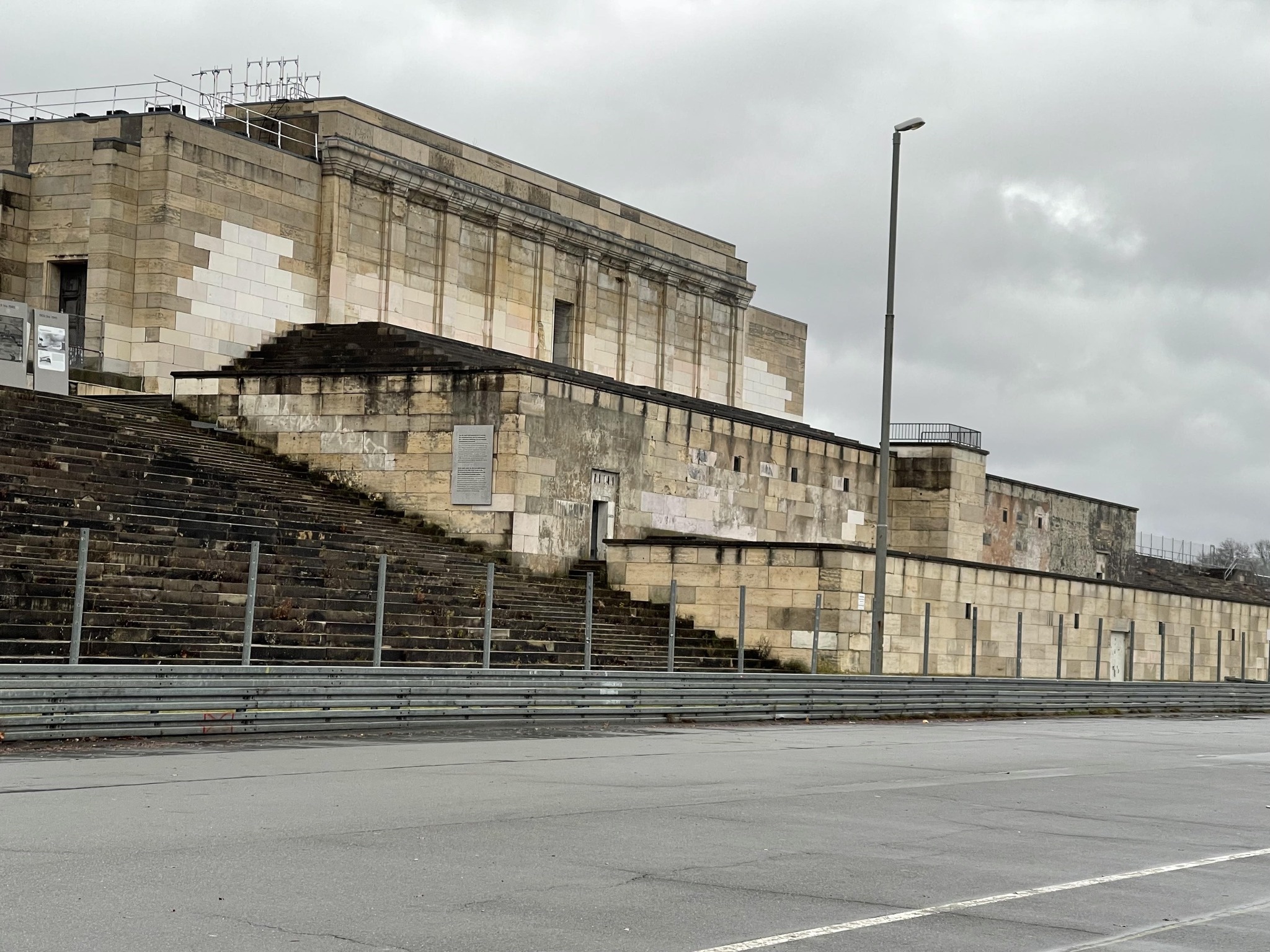
I also visited the courtroom where the Nürnberg trials were held after the war. The history was tangible, almost like the ghost of Göring was breathing down my neck. My parents and in-laws lived through that war, and Beth and I missed it by a decade. The temporal distance lessens the feeling of horror. For us, it was stories. For our parents, it was more than just headlines – it was the stories from the front, the news of relatives escaping a world gone mad, enlisting to fight in a war that made no sense.
But standing there, touching the stones, it hits you in the face. Do you feel the distance?
There are debates about what to do with these monuments to terror. The majority hold that should be preserved as tangible history, and I agree with them.
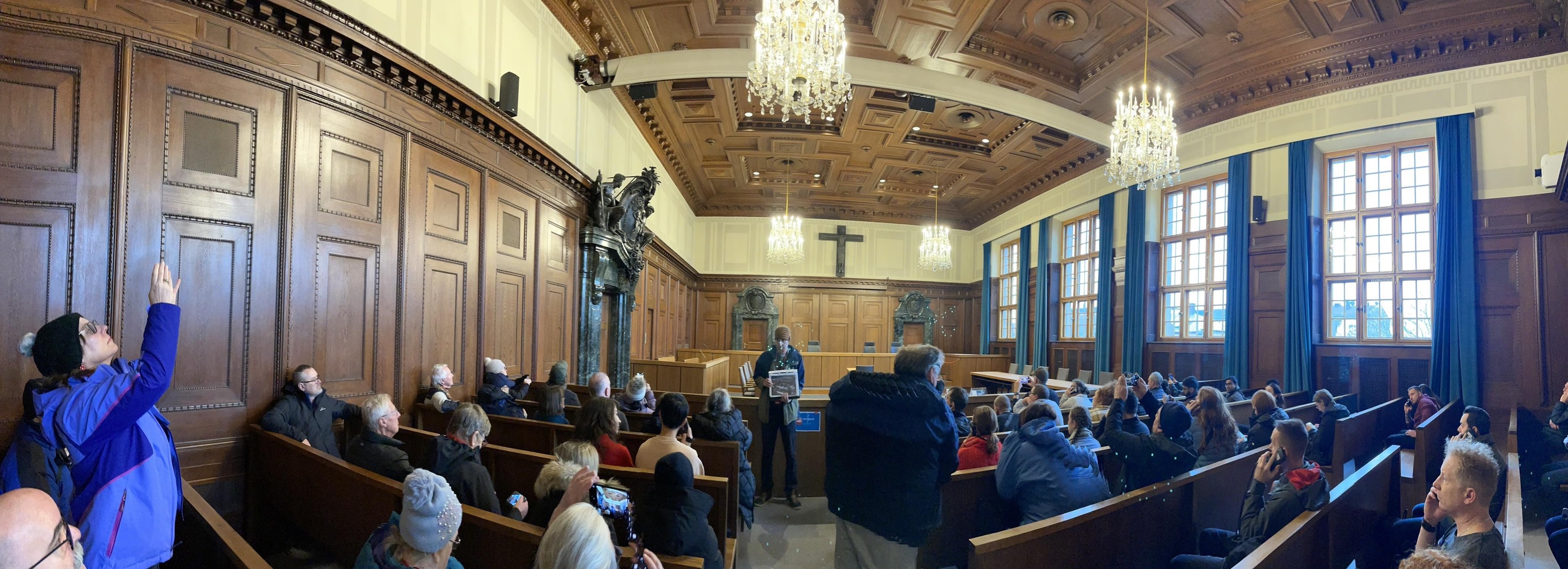
Day Three: Cologne (Köln)
I’m not a fan of large cities. Exhibit A: I used to live in the San Francisco Bay Area and today I live in rural Oregon. Exhibit B: In the Summer of 1976, I lived for three months in Los Angeles, and I still haven’t recovered.
As a city of 1 million residents, Cologne isn’t bad. It doesn’t smell like a big city – at least not the parts I visited. It’s clean, and it’s pretty. I still wouldn’t live there, but I don’t mind visiting. That’s not to say that Cologne doesn’t have big city problems: I was approached by three beggars while walking about.

Until today, my only use of the German language on this trip was to translate the label of a bottle of Coca-Cola, which didn’t have any high-fructose corn syrup, to the surprise of everybody sitting at the same table. And today, I failed my practical test when I asked for “Zwei heiße Schokolade, bitte” and the guy responded in English. Damnit! However, I later navigated conversations with a pharmacist (I asked for ibuprofen) and a barista (I asked for a small coffee to drink “für hier”.) without anybody getting their feelings hurt. I even told another pedestrian that, “Der Stadtbus ist dort drüben” when she asked for directions to a specific bus line.
We never left the vicinity of the cathedral, so I can’t tell you about the rest of the city. We went through two Weihnachtsmärkte but only purchased a small bag of roasted chestnuts and made a donation to an organization that is dedicated to removing trash from the Rhein. The Christmas market in the cathedral court had an unpleasant and unidentifiable smell so we didn’t stay too long. The second market was much nicer: Not as crowded, and no odor. It had a fairy tale theme.
I tried to capture this “glowing” tower on the cathedral. The light was reflecting off of the surrounding building with the sun low in the west. The undersides of the arches were brighter than the underside.



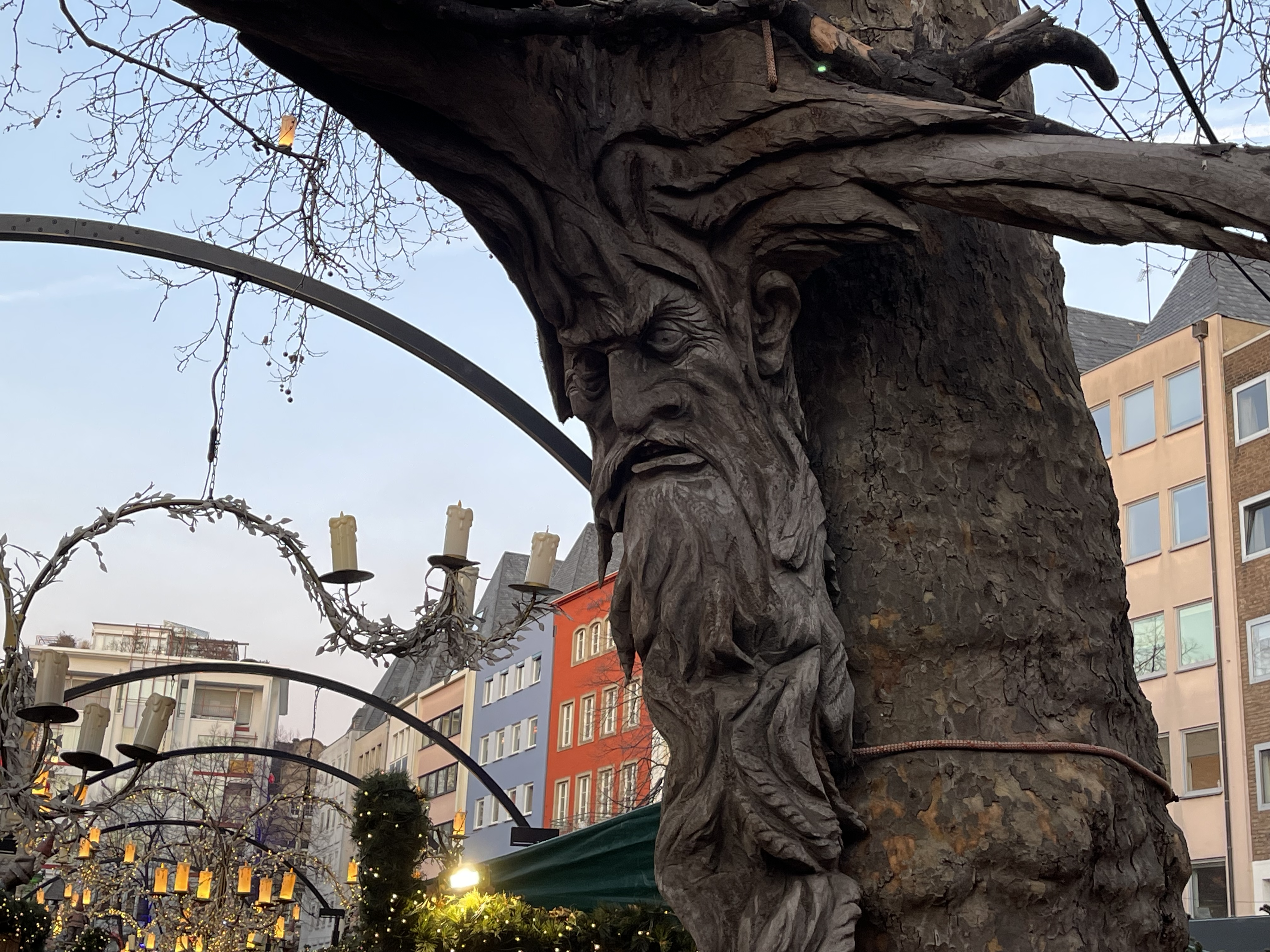

Tomorrow, Koblenz!
Day 2: Kinderdijk: It’s all about the windmills (and a water tower.)
After sailing all night, most of the passengers woke up on an overcast, blustery morning, with windchill at about 3° C (37° F) to something approximating this view. Kinderkijk is a World Heritage Site, and all 19 of the windmills, built centuries ago, still work. A tour guide told us that one may, upon conclusion of a 2-year education and passing a physically demanding test, rent one of these mills to live in and the rent is pretty cheap. He didn’t mention how long the wait list is, or if there is one.
According to the tour guide, Ukrainian refugees are living in the windmill shown below, though it can’t be very many. We saw the interior of a mill, and there’s about as much floor space as a single-bedroom apartment in the cheap part of town. They were built around 1740, and though their function has been replaced by modern pump stations, they still wor k and could be used if the modern plumbing stopped working.

We also saw this tower, which, according to Google, is an unused water tower and a historical monument.
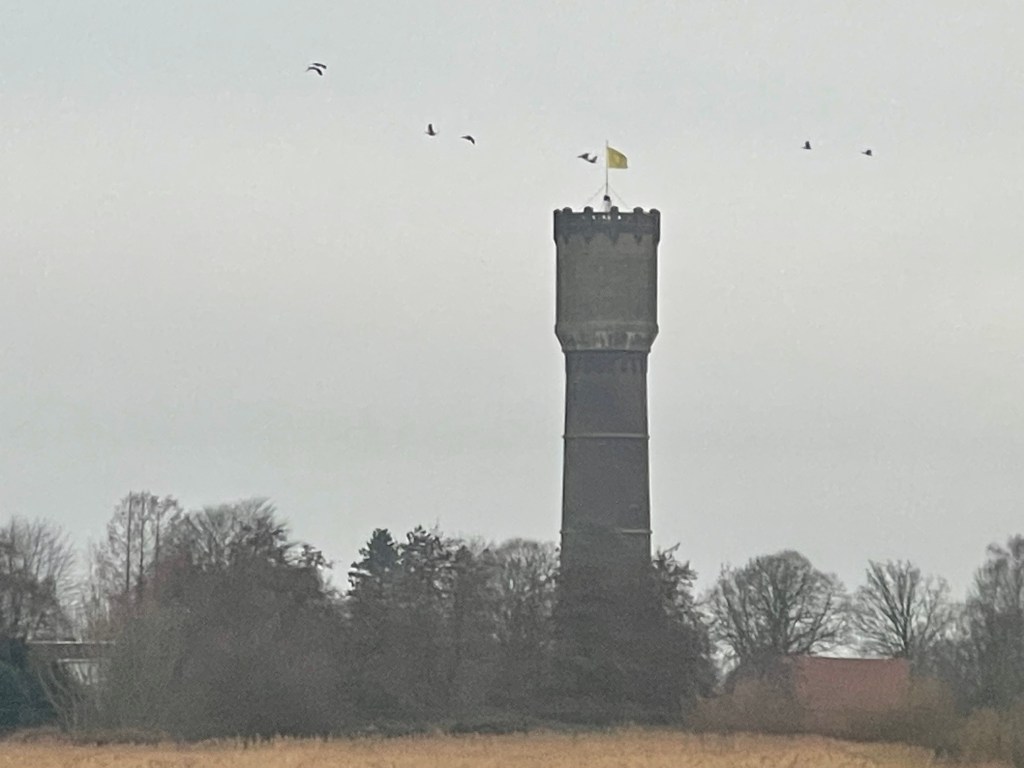
Sometimes the wildlife cooperates with the photographer. I only needed a few seconds for the geese to fly into the field of view.
Built in 1867, the water tower served as a backup to the windmills in times of high water, helping to keep the surrounding polders dry. There is a museum in the tower, but the tour guide never mentioned it, and we didn’t have time to visit it. The tower is 33 meters (109 feet) tall and 18 meters (59 ft) wide at the base.
Tomorrow we visit Cologne.
Day 1. Portland, Oregon to Amsterdam
It’s 03:30 on Sunday morning, and suffice it to say that my circadian rhythm is seriously messed up. While I’m sure that things will settle down in a day or two, it’s annoying.
We woke up at 06:30 on Friday to finish packing things like toiletries and last-minute additions to our suitcase inventory, made it to PDX by 10:00, and the plane departed right on time at 13:20.

I managed to get this photo of Mt. Hood while flying over Washington State with the iPhone. I discovered a good argument for dedicated cameras is manual focus. The iPhone wanted to focus on the window pane, and I had to do some manipulating to get it to focus on the damn mountain, and even then it was a dynamic thing, going in and out of focus. I waited until the mountain could be seen clearly before clicking the picture and it took several attempts to get this result, and I’m still not quite happy with it.
While the seats in Premium Economy weren’t uncomfortable, I could not get comfortable enough to fall asleep. We made it to Amsterdam at 07:30 local time, and I just had to take this picture of the sunrise.
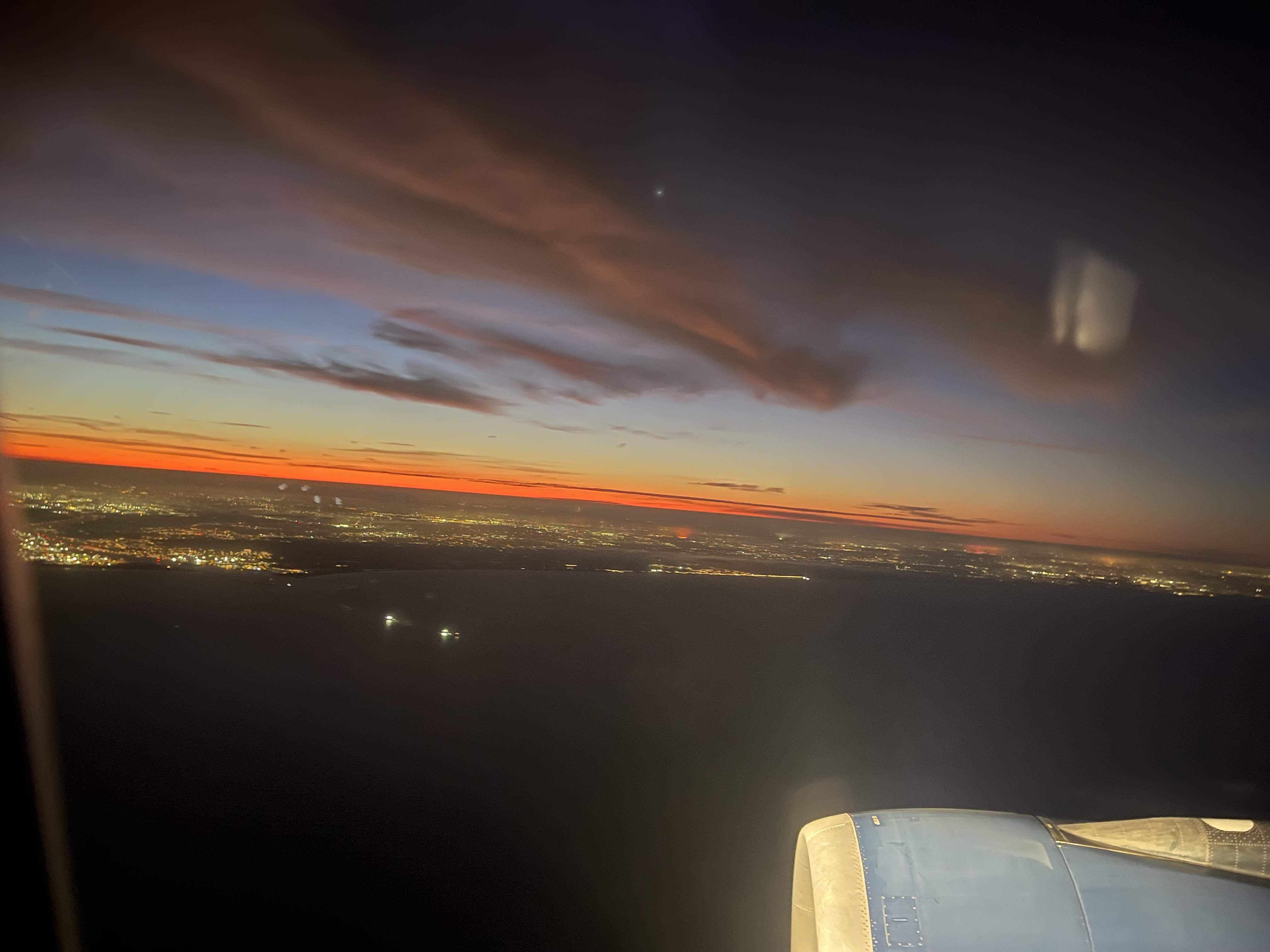
The starboard engine is illuminated so brightly because the landing lights were on, and that’s what the camera wanted to focus on. Fortunately, you can set the f/stop on an iPhone, so I cranked it as far up as possible while still getting the colors of the sunrise, giving a deep field of focus. Welcome to Amsterdam!
Amsterdam airport is huge! The aircraft taxied forever. Beth joked that we were going to get a tour of the city from the Airbus 330. We taxied for at least 15 minutes. Once we disembarked, things went smoothly. We breezed through passport control, and as far as we could tell, our luggage wasn’t searched. It was a short walk to where gofers from Viking Cruise Lines wrangled us into vans to take us to the docks.
Beth rode shotgun and reported that the driver ran through at least three red lights. Maybe it was the driver, or maybe Amsterdamers consider traffic signals to be mere suggestions, like New Yorkers. We only have the one data point, so it’s impossible to tell.
We finally arrived at the riverboat Viking Bragi but our stateroom wasn’t ready for us. We grabbed sandwiches in the lounge and tried to stay awake. By this time it was 11:30 locally and 02:30 in Oregon. Our stateroom became available at noon, and though the activities director announced that a tour of the city was available, we headed straight to bed. We only woke up long enough to participate in the mandatory safety drill.
We were instructed to put on the buoyancy vests located in the room. Instead of finding them in the convenient spot which was marked with a stylized life vest, they were stowed under the bed. Not just under the bed, but in the least accessible point under the bed, so that I had to get down on my knees, and then on my stomach to reach them. I am certain that this is a test to see if any passengers have orthopedic problems. I have abused my knees sorely in my lifetime, and they told me that there were only so many attempts to get the life vests left in their repertoire. So when the drill was over, I put them back in the spot with the life vest icon. However, while we were at dinner, house cleaning came in, made our beds, and threw the live vests back under the bed.
I told you: it’s a test. Considering that the average age of the passengers on this trip is about five years older than we are, I think it might also be an attempt at population control.
Three days to go. To Tip or Not to Tip?

I have a question for all you world travelers and residents of Europe.
Viking River Cruises has advised us, as American travelers, to always tip generously when we dine at local restaurants while in Europe. However, I’ve been told time and again, and have watched YouTube videos that say, “The rest of the world thinks that the American Tip Culture is weird, and servers in Europe actually get paid enough so that they don’t rely on tips.”
My intuition tells me that Viking wants to make sure that the people in European ports stay happy that their cruise line is docking in their city. “Here comes the Americans,” the locals might say. “Expect more money!”
Does Viking advise passengers from other countries to tip well?
If Americans stopped tipping so generously in Europe, would they be less welcome?
Do international relations have to be so transactional?
I’m looking forward to your feedback in breathless anticipation.
Eurotrip and Volcanos
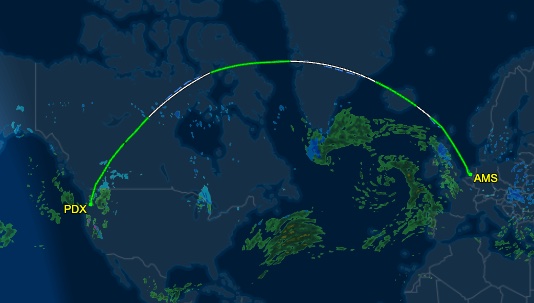
I noticed today that our flight from Portland, Oregon to Amsterdam in the Netherlands passes over Iceland, so I immediately checked on the status of the Fagradalsfjall volcano. According to Dr. Margaret Hartley, lecturer in Earth Sciences at the University of Manchester, the chance of a volcanic eruption is very high.
Working as an FAA Authorized Inspector in California, I remember all of the Notices to Airmen, or NOTAMs, that came out during previous eruptions. There were also a dozen or so Airworthiness Directives involving jets flying in the vicinity of a volcanic dust cloud.
According to the FAA, there are no current NOTAMs regarding the Icelandic volcano.
I don’t believe that, if Fagradalsfjall erupts, we’ll have to postpone or cancel the flight. I’m sure the airline will be able to find an alternate route.
According to the Icelandic Meteorological Office, there has been an increase in earthquakes, including larger tremors, indicating the movement of magma. There has also been some slight ground deformation in the area, which is another indication of a potential eruption.
Whether there is or is not an eruption is not anything we can do anything about, so I’m not going to worry. If there is one, we’ll deal with it.
Still, I found it an interesting coincidence.
Everybody loves maps
Three weeks and five days until we leave. Somebody will drive us to Portland, Oregon, then we’ll fly to Amsterdam and get on a boat. In the map below, I’ve coded the boat trip along four rivers in red, the flight from Budapest to Munich in Green, and the train route from Munich to Berlin in purple. There is also a small side trip from Passau to Salzburg.

Autumn comes to Oregon

Leaving for Europe in 50 days
“Why the hell are you visiting central Europe in the dead of winter?!” is a question I get a lot these days.
Yes, most of the cool cultural stuff in Europe happens in the warmer months. Lots of festivals and so much to do when the temperature is above freezing. But that’s also why it’s cheaper to visit in the Winter. Airlines, hotels, and local businesses charge less when there isn’t a horde of tourists descending on the location. Plus, there are all the cool cultural stuff that most people don’t see.
There are also fewer crowds. We’ll be able to more fully appreciate the experience, rather than cursing the lines of people. If you’ve ever been to Disneyland, and odds are, you have, then you can understand this.
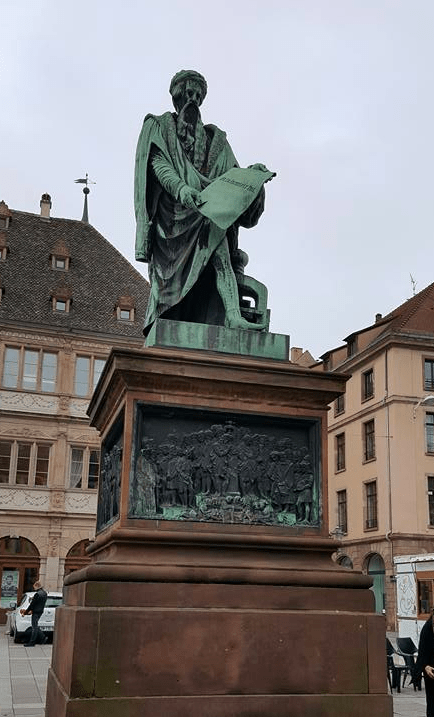
Gutenberg points out a typo.
I also believe that traveling in the off-season allows us to experience a more authentic Europe. Rather than pre-packaged tours, we can wander around, get lost, and interact with locals. We have booked some touristy things to do, like visiting the Lipizzaner stallions in Vienna, but we’re going to spend three days in Munich without planning much. We’ll be in Munich for the Silvester celebration (New Year’s Eve) and anything that happens will be totally spontaneous. Our hotel is a mere 250 meters from Marienplatz, and I don’t think we’ll be able to escape the event even if we wanted to.
I plan on walking through some of Germany’s famous Weihnachtsmärkte, including the ones the Cologne. In preparation for this, I asked Google for a map of the kölner Weihnactsmarkt, and it responded, “Here’s a list of all of them.”
“All of them? Hmm. This might be a busy day.”
I’ll be in Salzburg, Austria on December 25. Most of you know this town from The Sound of Music, but it’s also the birthplace of Mozart – and of course there’s a Mozart museum – and it’s also the location of the Stefan Zweig Center. (Feel free to google that.) Will these places be open on December 25? I’ll let you know.
There will also be opportunities to take stunning Winter photographs without a lot of people getting in the way. This point has started a conversation about whether we should take a dedicated and expensive camera, or just use the iPhone. The problem with cameras is that they are bulky and heavy, take up a lot of room in the suitcase, are prime targets of thieves, and require accessories like lenses and chargers. The iPhone is handy, small, and I’m going to take it anyway. While not as good for taking creative photographs, the iPhone camera comes with a lot of manual adjustments (I hate automatic exposures which can take all the excitement out of a photo), and I’ve been amazed at the quality of photos and videos taken with iPhones. If you have advice on this topic, please leave it in the comments.
I’m also going to buy a eSIM card so that I can have a local phone number. When we traveled to Europe in 2016, I tried to use Verizon’s services to navigate, but Google Maps said we were in Seville, Spain the entire time, though we were never in Spain. I intend to solve this with the local eSIM card. It’ll also be easier to make restaurant reservations.
I’ll be posting videos/photos (whether from the Pentax, the iPhone, or the GoPro) and stories here. Mark your calendar for December 15.
This is very exciting! Recognition from SFWA!
Last October, the Science Fiction and Fantasy Writers Association, SFWA, put out a call for submissions for a Storybundle with the tagline, “Space is Big. Really Big.” They were looking for space operas and the like. The managing editor at Water Dragon Publishing, Steven Radecki, contacted me and suggested that I submit Memory and Metaphor.
I consented, and Steven submitted it for me, along with other writers associated with his imprint. I didn’t think anything about it until this morning, Sunday, December 18, 2022, when I received another email from Steven saying that, along with 14 other stories, Memory and Metaphor had been selected!
Oh, my gosh!
I don’t want to get too far ahead of the schedule, and I’m told that things will happen in March of 2023. I will revisit this topic again then and give more details, but I felt like I had to share it with people!
Below. The universe of Memory and Metaphor. Yes, space is big. Scale is in lightyears.

Science Fiction Fandom at a Brew Pub
Had a wonderfully exciting conversation last night at a brew pub with three incredible fans of Trek and Wars. We talked about how people like Trek for its trekkiness and Star Wars for its camp, and some people really screwed up when they tried to make Trek more like Wars. We talked about how the Enterprise, far more than even Kirk, is the face of Trek. The Enterprise is a character in the franchise that people love, and the first time it was destroyed on-screen, people cried. But it was a huge mistake to then destroy the ship in every subsequent film.
Note to Directors: You have to let a character build a relationship with the audience before you kill it off for shock value. So put a moratorium on killing the Enterprise for a while.
As a subset of this conversation, we talked about one of the major differences between Trek and Wars. I feel compelled to point out that nobody in the conversation ever once said that one is better than the other. We all like both Trek and Wars. (This is allowed. I checked.) But if you refuse to acknowledge the differences, then you’re missing the point.
One such difference is how the two franchises treated the concept of fascism. The message from Wars: Fascism is bad, even if you have to fight it with religious fanaticism. We compared this to the TOS episode, Patterns of Force which discussed fascism not only in historical context but how it can come about even with the best of anti-fascist intentions.
How to find the last occurrence of a value in Apple’s Numbers spreadsheet
I know what you want to ask: Why are you using Numbers when Excel is so much better and more versatile? Excellent question! I ask myself that all the time.
There are many things you can do with Excel that can’t be done in Numbers, and it often seems like I find a new one every day. Let’s face it, Numbers isn’t intended for the same users as Excel.
That being said, I don’t like Excel and I don’t even have a good reason for it. Maybe it’s a natural aversion to monopolies or something. Maybe it’s dedication to a brand – I’ve been a loyal Apple user since the days of the Apple ][. Well, maybe not that loyal. I don’t like iPhones or iPads. But you should ask me about iGlasses sometime.
Regardless. I ran into a problem while creating a spreadsheet in Numbers. I was about to relent and create it in Excel when I ran into a similar problem.
How to Return the Last Occurrence of a Value from a List of Values. Here’s my problem in detail:
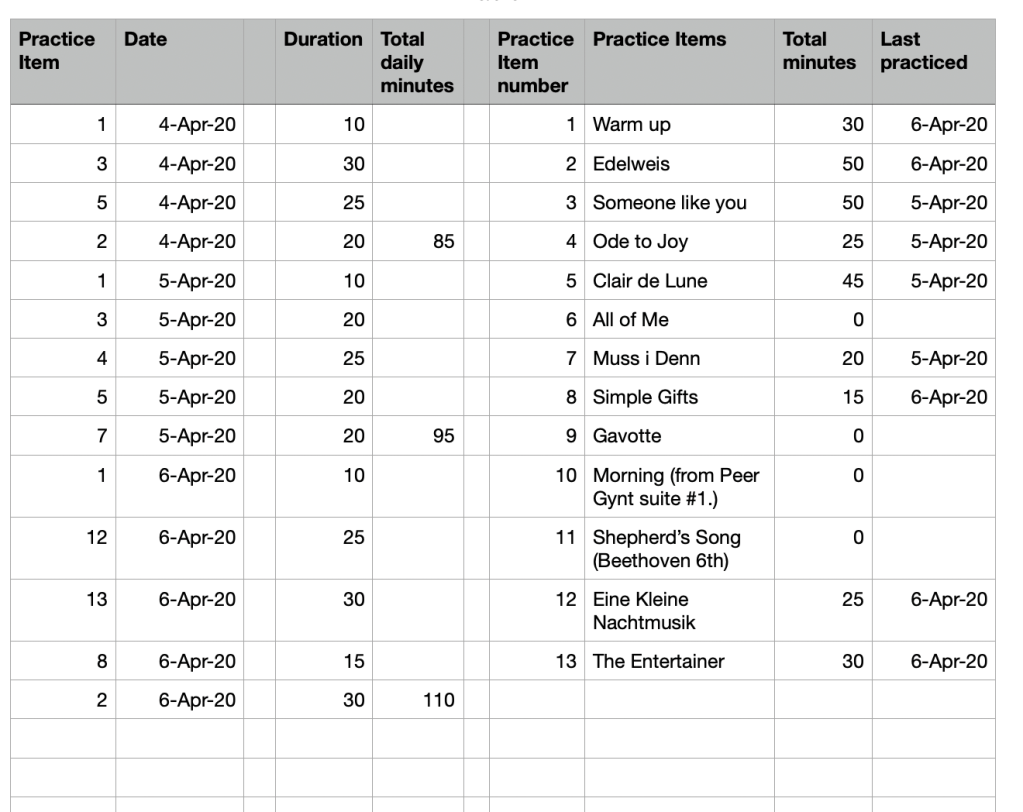
The Practice Items column is a list of the songs I’m currently practicing on the piano, and I want to keep track of how much time I spent practicing that piece and when I practiced it. The column in question is Last Practiced. I want a polite warning if I haven’t practiced a piece in a while.
The problem was getting that column to return the Last Time I Practiced It. For instance, I practiced Adele’s Someone Like You on April 4 and April 5, and I want April 5 to show up in the last column.
After messing around with Numbers for longer than I really should have, or longer than the problem really merited, I tried to do the same thing in Excel. To no avail. I was starting to feel really stupid.
So I googled the problem and found that different authors had presented three different ways to do it in Excel. And none of them will work in Numbers.
I was about to give up and use an Excel spreadsheet when my stubborn streak kicked in. There HAS to be a way to do this! So I made another pot of coffee and dug into it.
I used the template from the Excel solutions and modified the elements of the equation that returned errors in Numbers. My stubborn patience was rewarded.
If you came here looking for this solution, here it is: Ta da!
This is from the Someone Like You cell: IF(ISERROR(VLOOKUP(G4,Practice Item,1,0)),””,INDEX(Practice Item:Date,MATCH(G4,Practice Item,1),2))
The important part is INDEX(Practice Item:Date, Match(G4,Practice Item,1),2).
The if-iserror statement is simply so that it won’t put the last date on the list for items that I haven’t practiced.
I hope somebody finds this useful.
Water hardness off the charts!
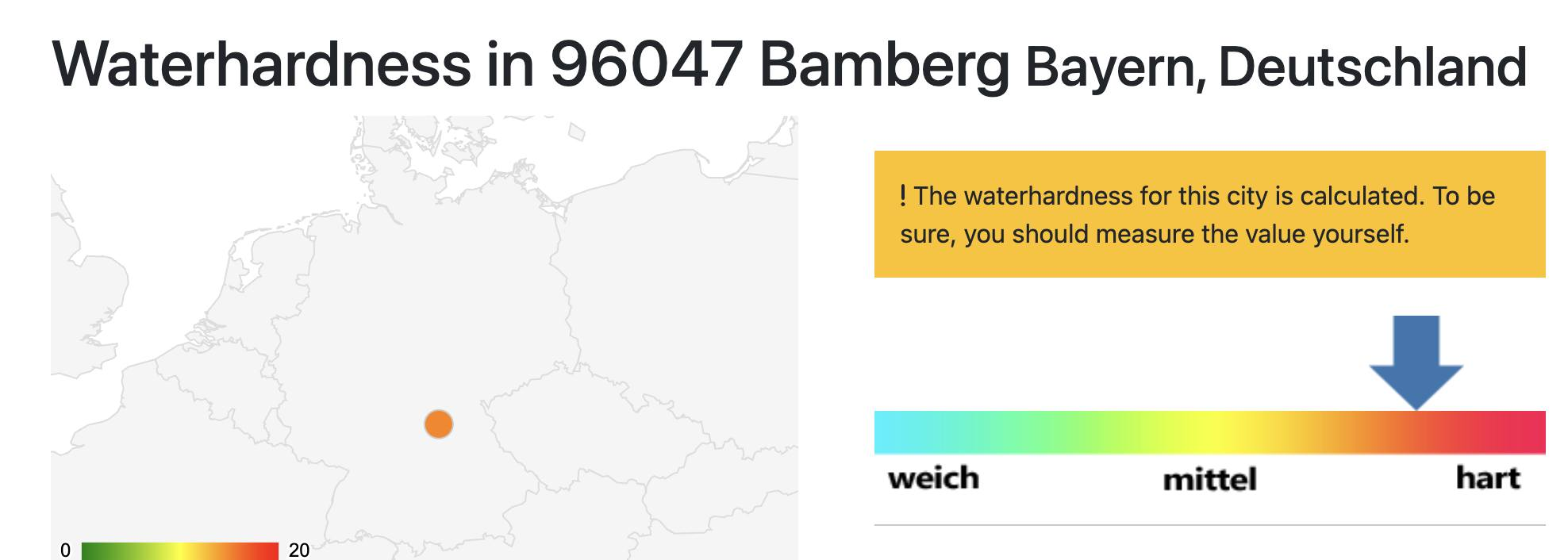
The water in Bamberg tastes like chalk, and this is not an exaggeration. See the image with the hardness chart. The soil around here is rich in Calcium carbonate (CaCO3) and magnesium carbonate (MgCO3). As the water filters through, it dissolves these minerals and delivers them to unhappy visitors from the U.S. who are unaccustomed to water that sticks to your teeth. There’s nothing unhealthy about it, but it’s unhealthy if you avoid drinking water that has the distinctive aftertaste of concrete.
Most people in the city have water softeners in their homes, but not my hosts. They serve water with every meal and sometimes beer. If the beer wasn’t available, I gritted my teeth and drank maybe four or five ounces. It tastes so bad that I had started to avoid drinking it, relying on coffee and cola to get my H2O intake. This wasn’t a good idea, and I started feeling cranky, lethargic, constipated, and moody, but I didn’t realize what was going on. My stupid self finally caught on that I was straddling the line on dehydration. I may have crossed the line entirely. In retrospect, I’m not sure I could even see the line anymore
I started buying bottled water. I dislike buying plastic bottles, but they have an excellent recycling system here, and it may have saved my life.
I explained the situation to my hosts, and they don’t seem to be insulted by me bringing bottled water to the meals. I was worried I would about that.
Feeling better. Studying isn’t so difficult anymore. I don’t feel lethargic or constipated. Take it from the experts (of which I’m not) that hydration makes your life more fluid and comfortable.
Two Months in Bamberg — day 7: An American’s Perspective.

I’ve posted about these before, but I think they bear repeating. These are stumble stones, or Stolpersteine, that commemorate victims of the Nazi regime. They are placed at the last known address of the victims, and act as a decentralized reminder. Though I suspect many in the current administration will claim that they’re part of some elaborate hoax. They are not just Jewish victims, but other victims of the regime.
They are not without controversy, obviously. The city of Munich has banned them on public property following criticism from the President of the Jewish Community there, who considers it disrespectful for the names of murdered Jews to be on the ground where people can walk over them.
Culture shocks of the Day:
My hosts serve dinner at about 8 in the evening. This has advantages and disadvantages. One advantage is that by the time we sit down for dinner, I’m so hungry I’m willing to eat most anything. It also allows for a later lunch, which is typical for me.
Also, they are enthusiastic consumers of vinegar — French for “sour wine.” It goes into most every dish, even dishes I would never consider pairing with acid. I’ve never been a fan of adding household cleaners to my meals. I suppose after eight weeks, though, I’ll grow to either enjoy it or really hate it.
Two Months in Bamberg, Germany. An American’s Perspective
Day 1

Culture shock of the day.
There are free-standing cigarette machines throughout the city. The weirdest thing is that their distribution seems to be random, and not associated with any retail outlet, although I’m unsure if they’re also present in residential areas.
The buyer’s age is checked by inserting a debit card. Not sure how valid that is.
I googled some data (take that for what it’s worth) and discovered that the teen smoking rate in Germany (14 to 17-year-olds, 2024) is 14.9% and shows signs of increasing. The rate in the U.S. is 1.7%, though the rate for vaping is much higher at 5.9%.
There are about 300,000 of these machines nationwide, mostly in areas of high pedestrian traffic. They started requiring age verification in 2007, usually with a debit card or national ID, but really, how hard is it to get your older sibling or cousin to cooperate?
Does the ease of purchasing tobacco have anything to do with these disparate rates? No idea. I suspect there are other variables that have a greater effect, like lower prices (tobacco prices in the U.S. are among the highest globally) and greater social acceptance of smoking.
It rained all day, and it wasn’t very tourist-friendly. I spent much of the day learning how to shop for groceries. There are as many differences as similarities between shopping in the U.S. and Germany, but one thing remains constant: Shopping for only one person is a pain in the patootie. Tomorrow I’ll move in with the host family, and meals will become both more complicated and easier.
Thoughts from the World’s Worst Test-taker.
I have two pieces of news to share with you. The first: I recently took an exam for a license from the Federal Communications Commission. This license allows me to press the “Push-To-Talk” button on an amateur radio and actually transmit in the amateur radio spectrum.
The test itself had all the drama of a tortoise race, but the results nearly caused my death.
I missed a question.
A single question! After all that time and effort studying the material, how could I miss one stupid, ridiculous question on the test? What gives? The test must be rigged! If it had cost me a dime, I would have demanded a refund!
I took a deep breath, centered myself, and decided that missing a single question on a 35-question test was not a valid reason for committing seppuku. I reminded myself of the old joke: “What do you call the person who gets the lowest passing grade in medical school?” The answer, of course, is “doctor.” For the record, the FCC doesn’t care if you barely pass or ace the test. It was the same when I took the tests by the Federal Aviation Authority. The passing grade is 70%, and our instructors went to great lengths to assure us, repeatedly, that acing a test won’t get you any more job offers than getting exactly 70%. Did that stop me from obsessing over every question? Take a guess. And if anybody received a better grade than I did, I was sure they cheated.

In case you’re wondering: yes, I’m always like this. I was impossible to live with during my university days.
“What do you mean I got one of Maxwell’s equations wrong? Who are you to decide if I got it wrong—I mean, besides the physics professor?” I’d then wander the halls of the dormitory, beating my chest and lamenting that I would never, ever graduate.
I’m sure there’s some psycho-argot label for people like me, and I’m equally sure it’s not flattering. While I understand the compulsion to categorize everything from quarks to quasars, in my entirely unqualified opinion, human behavior is far too complex to go around sticking reductio ad absurdum labels on people. Then again, I’m probably wrong. Just ask the people who write the tests. I’m sure they’d be happy to tell you exactly how wrong I am.
The second piece of news is that I’ll be leaving for Germany on October 2, 2025. I’ve enrolled in a German Language Immersion Course, and I’ll be there for eight and a half weeks, counting travel time. I’ll be staying with a host family who’ll look at me sternly every time I use English. I’m sure I’ll enjoy this adventure as long as I don’t have to take any stupid, ridiculous, infuriating, humiliating tests!
Why do our lives revolve around taking humiliating tests?! Tests, tests, tests! Every time I turn around, somebody is evaluating my performance on something. Jeez, give a gal a break!
Fortunately, I don’t need any language proficiency certificates. I don’t know what I’d do with one other than use it as a coffee filter. The only test will be when I order something from the grocer and they don’t break into giggles at my American accent, confirming their suspicions that all Americans are idiots.
You might be asking, “Andrea, why are you doing this? Radio electronics is hard! Physics is hard! German is hard!”
Aside from the non-committal, “It seemed like a good idea at the time,” I don’t have an answer for you, and, fortunately, my psychiatrist is forbidden by her oath to reveal my secrets. Besides, it’s not a question anyone has asked me. I’m just preparing for the day when someone might ask me on a test.
Thoughts While Sitting at the 2025 World Science Fiction Convention in Seattle.
Sitting in the dealers’ room at the 2025 World Science Fiction Convention (WorldCon) in Seattle. Wearing my replica TNG-era com badge and Starfleet delta earrings. I didn’t wear my Manticoran Navy officer’s uniform because my involvement in the TRMN has waned significantly. A gentleman sitting at the same table is wearing his uniform, and I said, “Go Manticore!”, but he ignored me.
My publisher threatened to take away my author card if I didn’t autograph copies of my books at his table. So, if you want some autographed books, you can head over to Water Dragon Publishing, or, better yet, send me an email and I’ll be happy to address an autograph to you personally.
The first ribbon I attached to my member badge says, “No Kings.” I picked it up at the registration desk before I even obtained my dealer badge (ribbon). Dozens of people have asked me where I got it, and when I tell them, they respond, “There weren’t any there when I went through registration.”
Sorry, dude. Can’t help you with that. I haven’t seen many No Kings ribbons, so I’m thinking they may have been a limited run.
I’m not seeing many panels on today’s schedule that I want to attend, but there is one at 19:30 tonight that looks interesting:
Why Does the Alt-Right Love Science Fiction?
The description: Over the past few decades, there have been attempts to co-opt science fiction in support of racist, sexist, and classist political movements. Even works such as Star Trek, Neuromancer, and The Dispossessed have been claimed by alt-right leaders as foundational texts for their awful worldviews. Why does the alt-right love science fiction, and what problematic assumptions are coded into the genre that cause it to be open to these interpretations?
First off, anyone who wonders, “When did Star Trek become so woke?” has had their head up their butt since 1966.
Second, I’m well aware that embracing science fiction fandom has placed me solidly in a progressive echo chamber. If the bulk of Sci-Fi fans had their druthers, The Felon and his cronies, along with all the White Christian Nationalists, would have been launched into a parallel universe long ago, where they can play out their Project 2025-basedmasturbatory fantasies without bothering other people.
That’s not to say that there aren’t any Republicans at the Con today, but they tend to keep their political opinions to themselves and quietly back out of conversations that turn political. And they tend to be the kind of Republican who’d vote for Eisenhower or Nixon, but not The Felon.
Thirdly, I have a dinner engagement tonight, but if I can get back to the Con before 19:30, I’ll attend this panel.
What do I do about the echo chamber? Truthfully, not much. I remind myself that the loudest progressives are just as guilty of not fact-checking their talking points as Fox News is. I mean, really, people just don’t google it when it supports their agenda.
Apropos of nothing, here is a Hawaiian Dalek.

Death by Cooties: A Martian Mystery
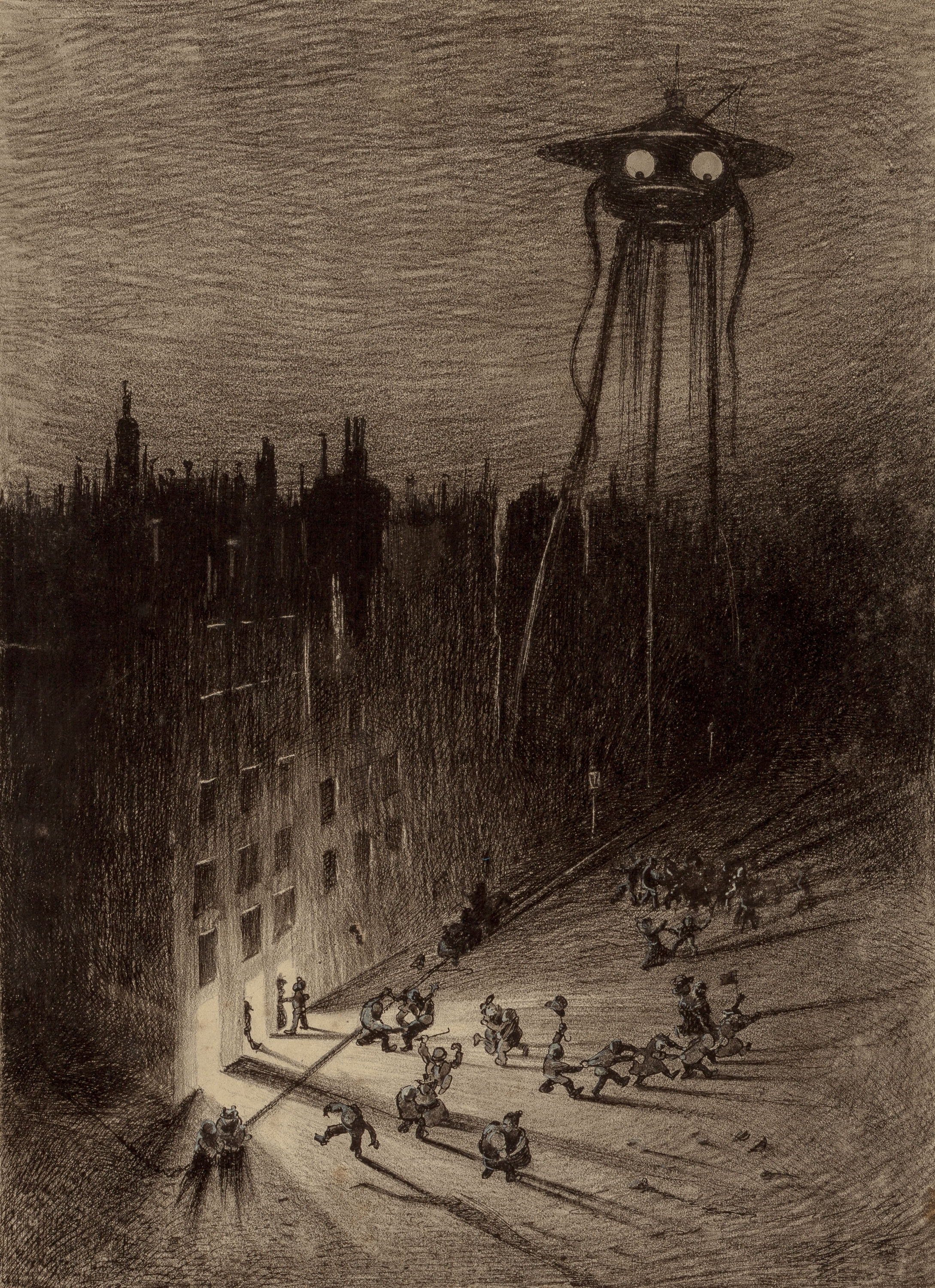
In H. G. Wells’ classic War of the Worlds, the invading Martians are defeated by microbes, to which the Martians have no immunity. When the book was written in 1898, the readers thought this was a clever turn of events. Wells needed a way to defeat the Martians without relying on conventional military victory, and used germs as a deus ex machina that relied on science and not gods, and showed how the hubris of the Martians was brought low by the humblest of life forms.
“And so the Martians fell… slain by the putrefactive and disease bacteria against which their systems were unprepared.” — H.G. Wells
However, 127 years later, it’s hard not to squint at this plot twist. I doubt my thoughts here are original, but they’ve been festering in my brain long enough that I feel compelled to write them down.
Plot Hole #1: Advanced Civilizations Should Know About Germs
First, the advanced Martian race should have known about germs and how to deal with them. After all, the existence of megafauna, such as the Martians, implies the existence of microorganisms, just as the existence of planets implies the existence of atoms. This is a humungous plot hole.
On Earth, microbes are ubiquitous, filling every possible environmental niche from the bottom of the ocean to the lint in your belly button. They are fundamental to every ecosystem, including the digestive systems of larger animals. It’s nearly impossible to conceive of a complex biological system capable of supporting megafauna, like the Martians or any other large creature on Mars, that does not also involve a vast microbial landscape.
Let’s ignore the realities of what we know about Mars and assume for a moment that the fourth planet has its own long evolutionary history. The Martians would have co-evolved with Martian pathogens and would have developed their own immune systems to deal with their native germs. The Martians would have almost certainly developed an understanding of disease, hygiene, and germ theory. They would have had their own plagues and epidemics throughout their history.
At some point before the invasion, some Martian scientists working for the Martian Space Agency would have said, “Y’know, we really should send a robotic probe to check out the air and water to make sure it’s safe for us.” Had they not considered this, then, shit. The universe has little patience for civilizations that skip the basic biohazard protocols.
Plot Hole #2: Why Would Earth Germs Recognize Martians as food?
The Martians evolved in a world completely isolated from Earth. What are the odds that Earth-based germs would find the Martians tasty? Or would even be able to find a way to infect them?
Our microbes on Earth have evolved over billions of years to exploit the organic molecules and metabolic pathways that we depend on: breathing, eating, and drinking. The micro-beasties have evolved enzymes and receptors to interact with Earth-based proteins, sugars, and lipids. We are in a biological arms race with germs — we develop immunity, and the germs find novel ways to infect us.
The converse is true with Mars. Earth-based microorganisms would probably not recognize Martians as food or a host.
Science Fiction, Not Science Fact — And That’s Okay
None of this is meant to disrespect Wells or the book. The War of the Worlds is a foundational work of science fiction, and its denouement is memorable, iconic, and metaphorically powerful. Wells used the science available to him in 1898 to craft a compelling narrative, even if it doesn’t stand up to 21st-century astrobiological scrutiny.
That said, the bigger question is this: Why does Hollywood keep falling back on such a well-trodden trope?
I know — the answer to that question is always “money.”
Every time we watch another remake of War of the Worlds, we already know how it ends. Spielberg used it less as science fiction and more as a mirror for Americans’ post-9/11 insecurities. But let’s be honest: if he hadn’t signed Tom Cruise, Dakota Fanning, Tim Robbins, and Morgan Freeman, I doubt it would’ve had the same impact.
And speaking of casting calls
One moment in Spielberg’s War of the Worlds (2005) that I genuinely appeciated was the cameo of Gene Barry and Ann Robinson — the stars of the 1953 adaptation — as the grandparents in the final scene. It was a graceful nod to the film’s lineage, acknowledging the cultural staying power of Wells’ story and the generations of audiences it has haunted (and inspired). For all my criticisms, I have to give Spielberg credit for honoring the franchise’s legacy.
Hands Off rally in Corvallis, Oregon
We had beautiful Spring weather in Oregon today. Clear, warm skies that invited tee-shirts and broad-brimmed hats. Thousands of people could have spent the day at the beach, or skiing, or kayaking on the Willamette River, or fishing. Instead, they chose to spend the afternoon showing solidarity against the gross man-child who spent the day watching a golf tournament in Florida while the country figuratively burned.
Americans want to know: Does this president make our country look stupid?
Getting Political Because I No Longer Have a Choice
Indivisible Oregon sent me a message on March 25, asking me if I’d help organize an event for the Transgender Day of Visibility in Salem, Oregon. Oh, boy! Six whole days to plan it! But, how could I say no?
Together with Heidi B., we pulled it off! I called the office of Andrea Salinas, the Congresswoman from Oregon’s 6th Congressional District, inviting her or a spokesperson to join us. They sent Mr. Brandon Jordan, who read a letter from Congresswoman Salinas.
Transgender individuals are under threat of erasure as one anti-trans law after another are introduced and passed in Republican controlled states, like this bill in Texas. Transpeople face unsafe conditions in about half the country. Imagine being out and about, and you have to hold your pee until you get home because using a public bathroom might get you arrested. I don’t like using clichés like “clear and present danger” or “unprecedented,” but this clearly is. The threat is clear enough that even cis-women are paying the price. Unless someone looks like a stereotypical woman, there is a chance that they’ll be targeted by the anti-trans militia. For instance, see this article. Any short-haired woman wearing baggy clothes could be targeted. As we saw at the 2024 Paris Olympics, any woman of color who outperforms white women could be accused of being secretly male.
It’s important to understand the flawed logic behind these attacks. If transgender women have such an unfair advantage in sports, why aren’t they dominating the competitions they’re entering?
Now I have three days until the “Hands Off” protest. The organizers did it right and gave us a month to get our act together, and I hope there’ll be sizable crowds in Corvallis, Davis, and Salem.
It’s against this backdrop of increasing legislative attacks and the very real dangers they pose that the ‘Hands Off!’ protests take on even greater significance. While the Hands Off protest isn’t specifically about Trans Rights, the core message of the Hands Off! protest is to tell Trump and Musk, “Hands off our lives! Hands off our Social Security! Hands off our bodies! Hands off our religion! Hands off our pensions!” If you’re able to join us this weekend at any of the hundreds of locations where protests are planned, your presence and voice will make a difference.
And, for those who might be questioning the impact of showing up, I offer this compelling video by the one and only Rebecca Watson, who details studies showing that protests actually do work.
The Constitutional Convention – Andrea argues with her characters.
Some background: I meet with a writers’ critique group every Friday, where we read our WIPs to each other and get instant feedback. I’m going to read this to the group this Friday. Of course, by commenting on the piece, they become part of the story.
The Constitutional Convention
A Meta Story about the Republic of Kentaurus
By Andrea Monticue
It was a cold, gray, rainy April morning in Monmouth, Oregon, and my Invicta Dive Watch indicated that it was still five minutes before the meeting started. I had the meeting invitation in my daypack, but I knew it by heart: Organizational Meeting. Noon. Public Library. Topic: What the hell, sistah? Bring your laptop. Other participants: Your literary creations.
This was not the first time my “literary creations” had forced a meeting of the minds on me. Usually, they didn’t bother with an invitation to a meeting – they just showed up at my office, helping themselves to my coffee, carrying a handwritten list of grievances. This always annoyed me, considering the advanced technology I’ve bequeathed to them. They have starships that travel at many multiples of the speed of light, for crying out loud! Can’t they invest in one measly iPad?
I walked into the library meeting room expecting to see the usual suspects and I was surprised to see some additional faces.
Bear stood near the door dressed in his medical corpsman uniform. He presented himself standing at a full seven feet tall, his tongue lolling over his wolfish teeth and his tail wagging to indicate pleasure at seeing me, greeted me at the door, and handed me a complimentary pair of smartglasses.
“Thank you, Bear! You’re always so thoughtful.” I was pleased that it was the better iGlasses from Apple and not the minimalist Google Viewer. Bear wasn’t able to reproduce human vocalizations, so he needed the translating ability of the smartglasses to participate. Everyone in the room was wearing them. This was good because, with the exception of Sharon Manders, the former UC Santa Cruz anthropology professor sitting at the podium on a stool, I was the only one there who spoke 21st-century English.
I set my daypack down on the nearest chair and donned the smartglasses while Sharon talked. “Thank you for showing up on time, Andrea.”
I gave her the finger then looked around the room. Teagan Wough with their unreadable mien, and Etta Place, dressed in a cowboy hat, tee shirt and jeans, were sitting to one side. Xoanna Campoverde, the Minister of the Navy on Kentaurus, and Elrydien Daerîsiell, the Elf who did Campoverde’s dirty, often extrajudicial work, sat next to each other opposite from Teagan and Etta. They both had their arms crossed in silent defiance.
The biggest surprise was Senator Robert Schoonover from the Annermani Province of Kentaurus, currently chairing the Senate Intelligence Oversight Committee. Despite his position, he wore casual slacks and a plaid vest over a simple cotton shirt.
“Bob,” I said, giving him a nod. “Always good to see you.” I greeted the rest with a glance and gritted teeth.
“Hey, boss,” he reflected and smiled. It’s always nice to have one’s fictional characters acknowledge who’s in charge, though I wondered if Bob was just being ingratiating.
The room was designed for business meetings with tables and hard chairs, an acoustic drop ceiling, and large windows facing the parking lot. Rain battered against the glass, causing a distraction.
Refusing to take a seat, I looked Sharon in the eyes and said, “Okay. What’s the deal? What are you pissed about now? You called this meeting, I’m sure.”
“Don’t get your dander up, Writer,” she said, raising a placating hand. “We actually think you’re doing a bang-up job on your current projects. We just feel that something is lacking.”
“Lacking?” I raised my voice louder than I intended to. “Lacking? Do you understand how many nights I lie sleepless in bed, thinking about the details of your universe?”
“C’mon, boss, that’s not fair,” Bob interjected. He was wearing that smiling politician’s face, designed to deescalate tensions among his constituents. “We’re not saying that world-building is easy or that you’re giving less than your all. Just hear us out, okay?”
“Yes, madam universe creator,” Xoanna said. Did she have the world’s sexiest accent or what? It made her sarcasm easier to swallow. “We merely want to point out a foundational lapse.”
“If I may,” Teagan interrupted. “Let me give you a scenario: The first paragraph of your first book mentions a ship traveling in space. This ship cannot just pop into existence without people to build it. And people infer a society with its attendant laws. But what are these laws?”
“I, uh, I’ve been creating them as necessary,” I offered.
“Yes, but is that fair?” Teagan said. “Especially since a solid hunk of the story takes place in a government setting.”
“Exactly,” Bob said. “How am I supposed to be a senator when I don’t know how the role is defined? What authority does my committee have? How was I elected, and who elected me?”
“The citizens, of course!” I said, feeling like I was pointing out the obvious.
“But what’s a citizen?” Xoanna asked. “Shouldn’t this be defined somewhere? And is it a direct vote, or do they choose their electors?”
I admitted internally that they had a point. “You’re asking me how the government is run. What its constitution is. That’s like asking me how the FTL engines work. I have no clue!”
“I’d like to point out that that isn’t entirely true,” Elrydien spoke for the first time. Everybody turned to look at her. “You have an education in physics, and you like to stay current on physics research. You’ve made an effort to incorporate this into the story without getting bogged down in details.”
“Yeah, that’s a good cure for insomnia,” I said.
“But look at the work you’ve done behind the scenes,” she continued. “You have literally pages of spreadsheets detailing stellar distances and how long it takes to travel between them. You’ve written detailed specifications on different models of starship engines. Your readers never see this stuff.”
“Almost sounds obsessive to me,” Bob said, smiling. If he was trying to disarm my defensiveness, he wasn’t doing the best job.
“You need a constitution,” Xoanna said.
I thought about all the work that goes into writing a modern constitution and nearly collapsed in imaginary exhaustion.
“Nobody has to see it,” Bob said. “But it will keep our interactions consistent, and you won’t have annoyed readers sending you emails, saying, ‘In your first book, you said that the Kentauran parliament is unicameral and consisted of representatives, but in the second book, you introduce Bob as a Senator.’”
“Good point,” Sharon said.
Shit. And Bob didn’t know the half of it.
“Is that what this is all about? Okay, you’re a representative.”
“That’s not the point!” Bob objected.
“Okay, I’ll retcon the parliament as bicameral.”
Bob blew air from puffed cheeks in frustration. “Look, I don’t care. You just need to be consistent, or fans will eat you up.”
“And you can work on it when you have to take a break from your WIPs,” Etta jumped in, referring to Works in Progress. “It’s not like there’s a f’king hurry. The only lives on the line are the ones in your overactive imagination.” I could tell she was actively trying to curb her sailor’s mouth.
“If I may,” Teagan interrupted. “I don’t know anybody who’s written a constitution for a space-faring society before. Although, it wouldn’t surprise me if David Weber has. You can take all those musty, centuries-old Earth constitutions and give them a post-modern twist. What other nascent nations have had to worry about multiple species, genetic manipulations, robots, and interstellar treaties?”
“I’m not a lawyer,” I said defensively. “And I’m not a politician, or a philosopher, or any of those things one needs to be to write a constitution.”
“You’re also not a starship captain,” Etta offered. “You’re also not a spy, or a sailor, or a combat aviator, or a quantum electrician, or a diplomat, or a roboticist, or an information specialist, or an anthropologist, or a —“
“Etta, enough,” Bear calmly interrupted with his synthesized voice that sounded like Laurence Fishburne.
“Oh, you get the idea. You’re none of these things that you write about.”
“It’s not just that,” I said apologetically. “You can’t write a constitution with just one voice. You need a chorus. It requires a meeting of the finest minds of that society. Otherwise, you risk expressing only a single ideology.”
“We can contribute,” Sharon offered.
“All of you,” I said, indicating the entire group with a gesture, “are me.”
“I do hope you don’t believe that you and I share ideals of what a government is supposed to do,” Xoanna said, sitting up straight, ready for a fight, looking as if she’d just been insulted.
“You can always take it to that critique group that meets on Fridays,” Bear said. “They certainly have a variety of opinions, more or less valid.”
I cringed. I could already hear the group’s questions and objections.
 Memoirs of an Earthling